"a discussion of U.S. foreign policy in the context of the 2008 presidential campaign. Senator Hagel examined the inventory of global challenges that the next president will inherit and the responsibilities of the presidential candidates to address these challenges."The speech was titled "Memo to the Candidates." You can read the full text here as a pdf.
Showing posts with label Speeches. Show all posts
Showing posts with label Speeches. Show all posts
Thursday, June 26, 2008
Senator Hagel's speech at the Brookings Institution
Today Senator Hagel delivered a speech to The Brookings Institution, an event described as

Monday, September 10, 2007
Hagel not running in 2008
Chuck Hagel has announced today that he will not be seeking a third term in the Senate and that he will not be running for Presdient.
Here is the text of Chuck Hagel's announcement today (the text from Sandhills PAC):
Here is the text of Chuck Hagel's announcement today (the text from Sandhills PAC):
Hagel Announces He Will Not Seek A Third Term In Senate
OMAHA, NE – United States Senator Chuck Hagel (R-NE) announced this morning that he will not seek a third term in the United States Senate and does not intend to be a candidate for any office in 2008. Below is a text of Hagel’s remarks delivered at the Omaha Press Club:
“I will not seek a third term in the United States Senate, nor do I intend to be a candidate for any office in 2008. It has been my greatest honor and privilege to serve my country and represent my fellow Nebraskans in the U.S. Senate. My family and I will be forever grateful for this opportunity and the trust placed in me by the people of Nebraska. It has enriched all of us.
I have always tried to live up to the promise I made to the people of Nebraska the day I announced my intention to seek this Senate seat. On March 30, 1995 I said, “I intend to be a Senator all Nebraskans can be proud of.” I hope I’ve done that, and made some contributions to our state and country along the way. History will sort that out.
I am proud of my Senate record and deeply grateful to all those who helped get me there and keep me there, and those who have worked so hard for the people of Nebraska—my staff. I would like to particularly thank Mike McCarthy, Ken Stinson and Lou Ann Linehan. I owe a great deal to these three individuals.I would have been unable to do my job without the love, wise perspective and constant encouragement of my wife Lilibet, my daughter Allyn and my son Ziller. My appreciation for their support is immeasurable. I would also like to thank my brothers, Tom and Mike, for their constant support and occasional brotherly constructive evaluations.
I said after I was elected in 1996 that 12 years in the Senate would probably be enough. It is. I have always believed that democracies work best when there is a constant cycle of new energy and ideas, and fresh leadership.
I will leave the Senate with the same enthusiasm, sense of purpose and love of my country that I started with. I leave maybe a little wiser, surely a little more experienced and with a very respectable amount of humility.
Public service has always been a big part of my life, and I hope to have another opportunity to serve my country in some new capacity down the road.
This afternoon, my family and I will return to Washington, and I will go back to work. I look forward to working as hard in the remaining 16 months of my Senate term for the people of Nebraska as I have over the last 11 years.
Thank you.”
Friday, February 23, 2007
"Hagel Speech on U.S.-Iran Relations at the University of Nebraska at Kearney’s Conference on World Affairs"
Senator Hagel gave a speech on Iran yesterday that is well worth a read. Reading this speech reminded me why I do this blog: we need Chuck Hagel, with his wisdom and insight in foreign policy, in the White House. Here are some excerpts:
Forces and events in the Middle East cannot be neatly categorized. The swirl of Middle East history creates layers upon layers of complexity. There is little transparency in the Middle East. That is a reality that is inescapable and cannot be assumed away. To ignore this reality is to risk being trapped by false choices....false choices such as the question, “which is worse – Iran with nuclear weapons or war with Iran?”The full text is available on his Senate website.
...
On Afghanistan, the United States and Iran found common interests – defeating the Taliban and Islamic radicals, stabilizing Afghanistan, stopping the opium production and flow of opium coming into Iran. From these common interests emerged common actions working toward a common purpose. It was in the interests of Iran to work with the U.S. in Afghanistan. It was not a matter of helping America or strengthening America’s presence in Central Asia. It was a clear-eyed and self-serving action for Iran.
...
Two-thirds of Iran’s population is under the age of 30. Iran is undergoing a generational shift that will shape Iran’s outlook...and its opinions of the United States...for decades to come. Iran’s young people use the internet in large numbers, wear American jeans, listen to American music and are positive about America and the West. We do not want to lose this pro-American generation by turning them away from us. They are the hope of Iran. They bristle under the heavy yoke of the Ayatollahs’ strident limitations of personal freedom.
...
it was President Reagan who, in 1986, almost reached an agreement with Soviet leader Mikhail Gorbachev to abolish nuclear weapons. President Reagan understood the need for America to engage...to understand our friends and our adversaries...to explore our options...to identify common interests. President Reagan understood that great powers engage because they are secure in their beliefs and purpose but humble and wise in their policies and actions.
...
We are living today at an historic transformational time in history. The great challenges of the 21st century will require U.S. leadership that is trusted and respected, not feared nor resented. America cannot project only military power. Inspirational leadership and confidence in America's purpose, not imposed power, will be essential for world peace. If we fail, we will lose the next generation in Iran and around the world. This would result in a far more dangerous world than any we have ever known.
Thursday, February 15, 2007
Three new speeches/statements
Chuck Hagel's Senate website has some new material up that's worth checking out:
"Hagel Floor Statement on Iraq War Resolution -- February 12, 2007"
"Hagel Floor Statement on Iraq War Resolution -- February 5, 2007"
"Hagel Charter Day Speech at the College of William and Mary"
Thanks to Andy for the tip.
"Hagel Floor Statement on Iraq War Resolution -- February 12, 2007"
"Hagel Floor Statement on Iraq War Resolution -- February 5, 2007"
"Hagel Charter Day Speech at the College of William and Mary"
Thanks to Andy for the tip.
Monday, December 18, 2006
Senator Hagel's address at UNL
The commencement address at the University of Nebraska - Lincoln this December was delivered by Chuck Hagel. Here is his speech, from his Senate website.
After 60 years of living, I still do not have all the answers to life. But I have learned some things. I’d like to share five lessons I have learned over those years that might be of some use to you as you look forward from this day.
Mark Twain once said, “Twenty years from now you will be more disappointed by the things you didn't do than by the ones you did do. So throw off the bowlines. Sail away from the safe harbor. Catch the trade winds in your sails. Explore. Dream. Discover.” Twain said it very well.
Lesson 1: Take risks and seek new experiences. Nothing worth having in life comes without the risk of failure. Don’t be afraid to fail. Failing to try is worse than failing to achieve. Your generation will have more options than any generation of Americans. Take advantage of them. Seek out new challenges.
“...the man who really counts in the world is the doer, not the mere critic— the man who actually does the work, even if roughly and imperfectly, not the man who only talks or writes about how it ought to be done.”
Theodore Roosevelt
Lesson 2: Do what is ethical, not just what is legal. Too often, especially in Washington, we define our standards of conduct by legality. We blow past the ethical boundaries. There is a difference between ethical and legal conduct. Hold yourself to a higher standard than simply what you can get away with. Don’t play on the legal edge. Don’t cut corners. Compete with yourself...and you’ll always be honest with yourself.
During your life, when you are faced with difficult decisions, almost always, you will know that the right thing to do...is the right thing to do. Do it. Listen to yourself and be guided by what you believe is right. Standing against the crowd and doing what you think is right may be very lonely at the time, but it will serve you well over the long haul.
“Laws control the lesser man. Right conduct controls the greater one.”
Chinese Proverb
Lesson 3: Continue your education. The University of Nebraska has given you a tremendous start in life, but it is only a start. Do not lose your sense of curiosity and quest for improvement. Read, read, read and then read some more. The world in which you will be working will be more competitive than any generation has ever known. Education is a lifelong pursuit...it will prepare you professionally and enhance you personally. Remember, that you will be limited professionally if you hold back personally.
“Learning from experience is a faculty almost never practiced.”
Barbara Tuchman
Lesson 4: Give something back. Every graduate here today has traveled a different path, but you all have something in common. You all benefitted from living in a country that allowed you the opportunity to receive a first-rate education. That shared bond also comes with a shared responsibility to give something back to your country. Whether it is mentoring a child, serving in the military, running for office, or volunteering for a noble cause, this country will provide you countless everyday meaningful opportunities to give something back to society. Patriotism is an old fashioned value, but it never outlives its time. We all have an obligation in life to help make a better world for all people.
“We make a living by what we get, but we make a life by what we give.”
Winston Churchill
Lesson 5: Remember what really matters in life. We live in an age of instant communication and gratification. In many ways this has made our lives easier to live and more productive than ever before, but the constant challenge for you in this “immediate world” will be to ensure that it does not diminish the things that are most important in life. Everyone who will walk across this stage this morning is here because family and friends helped you get here. In life, it is family and friends that matter most. Do not forget that.
Don’t hold back your enthusiasms or dim your passions for your beliefs, loves and interests. Commit yourself fully, knowing that life will at times be unfair– but will always even out in the end. Regrets are painful to live with. You’ll have some– but you don’t want too many.
“It's faith in something and enthusiasm for something that makes a life worth living.”
Oliver Wendell Holmes
You are graduating at a special time. The world is undergoing a historic time of transformation and redefinition. These great moments in history come about twice in a century. Embrace this time to be alive and engage yourself in every part of it. Think of the opportunities you have to help shape the future of mankind. You will have the opportunity to do more good, for more people than any generation in the history of man. Don’t squander it.
The longer you live, the more you will realize that the two indispensable requisites in life are character and courage. Life is not worth much without them. The currency of life is trust– a product of character. The spirit of life is faith– a product of courage. Never lose them. For no matter the depth of despair or the difficulty of the dilemma– they will see you through. Ralph Waldo Emerson said: “character is higher than intellect.” This too you will come to recognize more and more.
We’re proud of you. Congratulations. You’re now Huskers for life!
Friday, July 28, 2006
Senator Hagel's Speech at the Brookings Institution
Today Chuck Hagel gave a speech titled “A Defining Time for 21st Century American Leadership” at the Brookings Institution, a think tank in Washington D.C. My appologies for the length of the post, but the whole speech was worth sharing.
----------------------------------------------------------------------------------
Technorati tags: Senator Chuck Hagel, Brookings Institution, Middle East, Leadership
----------------------------------------------------------------------------------
“A Defining Time for 21st Century American Leadership”
U.S. Senator Chuck Hagel
Remarks as Prepared for Delivery at the Brookings Institution
July 28, 2006
I am honored to be invited to speak here today as a part of the Brookings Institution’s 90th Anniversary Leadership Forum. Brookings has been at the center of every important policy debate in this country for 90 years. Thank you to Strobe Talbot, Carlos Pascual and all the men and women of Brookings for your continued contributions to our national debate. I see Martin Indyk and Ken Pollack in the audience. Thank you for the fine work you do with the Saban Center for Middle East Policy.
As we recognize the 90th Anniversary of the Brookings Institution, it is instructive to reflect back on the world of 1916 when Brookings was born...then known as the Institute for Government Research. In 1916, the world was in a period of wrenching and bloody transition. War raged in Europe. It was a war triggered by a series of tragic misjudgements stemming from decades-old resentments and shifting European alliances. It was a war fueled by the Industrial Revolution...the most deadly war the world had ever known. Within one year, the United States would shake-off its historic isolationism and engage in its first global conflict.
The Treaty of Versailles brought an end to the fighting, but it did not bring resolution. The United States retreated from a position of world leadership and back into its shell of irresponsible isolationism...the world economy collapsed, and lingering global resentments continued to heighten. Roughly twenty years later, harsh post-war reparations and arrogant nationalism gave rise to an even deadlier period of global transition: World War II.
America’s leaders following World War II learned from the failed and dangerous polices of the first half of the 20th century. After World War II, the United States became the indispensable global leader. Along with our allies, we created organizations of global interests and common purpose like the United Nations, the General Agreement on Tariffs and Trade (now the World Trade Organization), NATO, the World Bank, the International Monetary Fund and dozens of other multilateral institutions. Leaders like Truman, Marshall, Acheson, Hull, Vandenberg and Eisenhower led in the rebuilding of Europe and Japan.
Ninety years after the creation of the Brookings Institution, we live in a different world...but once again a world in transition. The lessons learned after World War II still apply. American leadership is still indispensable in the world...and the institutions and alliances formed after World War II are as vital today as when they were formed.
For decades, the United States used its power and influence to help forge international consensus on vital issues. America’s leadership inspired the trust and confidence of a generation of governments and nations around the world... because we pursued common actions that reflected common interests with our allies...because we remained committed to global engagement...and because we exercised our power with restraint. We made mistakes. It was imperfect. There were differences with our allies. But despite the imperfections and shortcomings, the United States and its allies contributed to world stability and the spread of freedom and prosperity.
Today, the world and America are in deep trouble. In a speech before the Council on Foreign Relations last November, I warned that the world’s trust and confidence in America’s purpose has seriously eroded. America is increasingly not seen as the well-spring of consensus that for decades helped create alliances and coalitions grounded in common objectives and common interests.
This is in contrast to a very troubling trend toward isolationism that is emerging in America today – a trend that was reflected in this week’s New York Times/CBS News poll of Americans about our country’s role in the world. This trend is a looming concern that may not be obvious but is manifest across seemingly unconnected events and issues. We must avoid the trap of limiting our power by allowing ourselves to become isolated in the world. America must not allow itself to become isolated through mindless isolationist remedies to difficult and complicated problems.
In the 1930s, the threat of Adolph Hitler’s Nazi Germany was not taken seriously. Most did not recognize this threat until World War II was upon them. But there was a voice sounding an alarm. Throughout the 1930s, Winston Churchill urged his countrymen and Europe to see the world through the clear lens of reality – not through the blurred lens of misplaced hope. On October 3, 1938, the House of Commons debated the Munich Agreement that Prime Minister Chamberlain had negotiated with Hitler. Many saw this agreement as the assurance of peace with Germany. Churchill disagreed. He said:
“Can we blind ourselves to the great change which has taken place in the military situation, and to the dangers we have to meet? This is only the beginning of the reckoning. This is only the first sip, the first foretaste of a bitter cup which will be proffered to us year by year unless by a supreme recovery of moral health and martial vigour, we arise again and take our stand for freedom as in the olden time.”
Today, there is no such threat to world order. Global threats today are less defined than Hitler. However, the challenges are more insidious, more difficult to comprehend and identify, yet more interrelated, more dynamic, and more dangerous. In the 21st century, we are confronted by a universe of challenges, threats, and opportunities unlike any that we have ever known. The margins of error for miscalculation are less than ever before. Dramatic shifts in security, stability and prosperity can occur in weeks or even days.
On April 16, 1953, President Dwight D. Eisenhower delivered a speech before the American Society of Newspaper Editors that we now know as the “Chance for Peace” speech. In the aftermath of the death and destruction of World War II and the ongoing war in Korea, the world then was confronted with the threat of the Soviet Union and communism. A different time. A different generation. Yet, Eisenhower’s words and wisdom still ring true today. He said,
“No nation's security and well-being can be lastingly achieved in isolation but only in effective cooperation with fellow-nations.”
Just as Eisenhower said in 1953, America’s security, prosperity and freedom cannot be separated from the dangers, challenges, and opportunities abroad. There are no national boundaries from terrorism, proliferation of weapons of mass destruction, pandemic disease, environmental degradation, and despair. No nation, unilaterally, possesses the power to defeat the threats of the 21st century. A global society underpinned by a global economy is our world today. The world’s problems and dangers are interconnected. Nowhere are these realities clearer than in the Middle East.
The Middle East is a region in crisis. A continuous and escalating volley of violence has the potential for wider regional and global conflict. Centuries-old religious, ethnic and tribal hatreds and tensions are being manipulated by Islamic extremists for their own unholy purpose. The Middle East is today as combustible and complex as it has ever been. More than fifty percent of the world’s proven oil and natural gas reserves reside in this troubled land...at a time when the world’s six and a half billion people rely on these resources in an interconnected world economy. Uncertain popular support for regime legitimacy continues to weaken governments of the Middle East. Economic stagnation, persistent unemployment, deepening despair and wider unrest enhance the ability of terrorists to recruit and succeed. An Iran with nuclear weapons raises the specter of broader proliferation and a fundamental strategic realignment in the region, creating more regional instability.
America’s approach to the Middle East must be consistent and sustained, and must understand the history, interests and perspectives of our regional friends and allies.
The United States will remain committed to defending Israel. Our relationship with Israel is a special and historic one. But, it need not and cannot be at the expense of our Arab and Muslim relationships. That is an irresponsible and dangerous false choice. Achieving a lasting resolution to the Arab-Israeli conflict is as much in Israel’s interest as any other country in the world.
Unending war will continually drain Israel of its human capital, resources, and energy as it fights for its survival. The United States and Israel must understand that it is not in their long-term interests to allow themselves to become isolated in the Middle East and the world. Neither can allow themselves to drift into an “us against the world” global optic or zero-sum game. That would marginalize America’s global leadership, trust and influence, further isolate Israel, and prove to be disastrous for both countries as well as the region.
It is in Israel’s interest, as much as ours, that the United States be seen by all states in the Middle East as fair. This is the currency of trust.
Israel, Lebanon and the Palestinian territories have experienced devastating violence in the last couple of weeks. The world has rightly condemned the despicable actions of Hezbollah and Hamas terrorists who attacked Israel and kidnapped Israeli soldiers. Israel has the undeniable right to defend itself against aggression. This is the right of all states.
Hezbollah is a threat to Israel, to Lebanon and to all who strive for lasting peace in the Middle East. This threat must be dealt with, as Israel’s military operations continue to weaken Hezbollah’s capacity for violence.
However, military action alone will not destroy Hezbollah or Hamas. Extended military action will tear apart Lebanon, destroy its economy and infrastructure, create a humanitarian disaster, further weaken Lebanon’s fragile democratic government, strengthen popular Muslim and Arab support for Hezbollah, and deepen hatred of Israel across the Middle East. The pursuit of tactical military victories at the expense of the core strategic objective of Arab-Israeli peace is a hollow victory. The war against Hezbollah and Hamas will not be won on the battlefield.
To achieve a strategic shift in the conditions for Middle East peace, the United States must use the global condemnation of terrorist acts as the basis for substantive change. For a lasting and popularly supported resolution, only a strong Lebanese government and army, backed by the international community, can rid Lebanon of these corrosive militias and terrorist organizations.
President Bush and Secretary Rice must become and remain deeply engaged in the Middle East. Only U.S. leadership can build a consensus of purpose among our regional and international partners.
The Rome meeting of the Lebanon core group this week must be the beginning of a very intensive diplomatic process – at the highest levels – with the objective of ending the military conflict, securing the Israel-Lebanon border, and invigorating the political track. To lead and sustain U.S. engagement, the President should appoint a statesman of global stature, experience and ability to serve as his personal envoy to the region who would report directly to him and be empowered with the authority to speak and act for the President. Former Secretaries of State Baker and Powell fit this profile.
America must listen carefully to its friends and partners in the region. Saudi Arabia, Egypt, Jordan and others – countries that understand the Middle East far better than we do – must commit to help resolve today’s crisis and be active partners in helping build a mechanism to move toward realizing the already agreed-upon two-state solution.
A robust international force deployed along the Israel-Lebanon border will be required to facilitate a steady deployment of a strengthened Lebanese Army into southern Lebanon to eventually assume responsibility for security and the rule of law. The UN Security Council should negotiate a new binding resolution that strengthens its demands to disarm militias and to remove Syrian influence from Lebanon that were made in UN Security Council Resolution 1559, and commits the international community to help Lebanon re-build its country.
The core of all challenges in the Middle East remains the underlying Arab-Israeli conflict. The failure to address this root cause will allow Hezbollah, Hamas and other terrorists to continue to sustain popular Muslim and Arab support, continuing to undermine America’s standing in the region, and the governments of Egypt, Jordan, Saudi Arabia, and others – whose support is critical for any Middle East resolution.
The United States should engage our Middle East and international partners to revive the Beirut Declaration, or some version of it, proposed by King Abdullah of Saudi Arabia and adopted unanimously by the Arab League in March 2002. In this historic initiative, the Arab world recognized Israel’s right to exist and sought to establish a path toward a two-state solution and broader Arab-Israeli peace. Even though Israel could not accept it as written, it represented a very significant “starting point” document initiated by Arab countries. Today, we need a new Beirut Declaration-type initiative. We squandered the last one.
The concept and intent of the 2002 Beirut Declaration is as relevant today as it was in 2002. An Arab-initiated Beirut-type declaration would re-invest regional Arab states with a stake in achieving progress toward Israeli-Palestinian peace. This type of initiative would offer a positive alternative vision for Arab populations to the ideology and goals of Islamic militants. The United States must explore this approach as part of its diplomatic engagement in the Middle East.
Lasting peace in the Middle East, and stability and security for Israel will come only from a regionally-oriented political settlement.
Former American Middle East Envoy Dennis Ross once observed that in the Middle East a process is necessary because process absorbs events...without a process, events become crises. He was right. Look at where we are today in the Middle East with no process. Crisis diplomacy is no substitute for sustained, day-to-day engagement.
America’s approach to Syria and Iran is inextricably tied to Middle East peace. Whether or not they were directly involved in the latest Hezbollah and Hamas aggression in Israel, both countries exert influence in the region in ways that undermine stability and security. As we work with our friends and allies to deny Syria and Iran any opportunity to further corrode the situation in Lebanon and the Palestinian territories, both Damascus and Tehran must hear from America directly.
As John McLaughlin, the former Deputy Director of Central Intelligence recently wrote in the Washington Post,
“Even superpowers have to talk to bad guys. The absence of a diplomatic relationship with Iran and the deterioration of the one with Syria -- two countries that bear enormous responsibility for the current crisis -- leave the United States with fewer options and levers than might otherwise have been the case. Distasteful as it might have been to have or to maintain open and normal relations with such states, the absence of such relations ensures that we will have more blind spots than we can afford and that we will have to deal through surrogates on issues of vital importance to the United States. We will have to get over the notion that talking to bad guys somehow rewards them or is a sign of weakness. As a superpower, we ought to be able to communicate in a way that signals our strength and self-confidence.”
Ultimately, the United States will need to engage Iran and Syria with an agenda open to all areas of agreement and disagreement. For this dialogue to have any meaning or possible lasting relevance, it should encompass the full agenda of issues.
There is very little good news coming out of Iraq today. Increasingly vicious sectarian violence continues to propel Iraq toward civil war. The U.S. announcement this week to send additional U.S. troops and military police back into Baghdad reverses last month’s decision to have Iraqi forces take the lead in Baghdad...and represents a dramatic set back for the U.S and the Iraqi Government. The Iraqi Government has limited ability to enforce the rule of law in Iraq, especially in Baghdad. Green Zone politics appear to have little bearing or relation to the realities of the rest of Iraq.
The Iraqis will continue to face difficult choices over the future of their country. The day-to-day responsibilities of governing and security will soon have to be assumed by Iraqis. As I said in November, this is not about setting a timeline. This is about understanding the implications of the forces of reality. This reality is being determined by Iraqis – not Americans. America is bogged down in Iraq and this is limiting our diplomatic and military options. The longer America remains in Iraq in its current capacity, the deeper the damage to our force structure – particularly the U.S. Army. And it will continue to place more limitations on an already dangerously over-extended force structure that will further limit our options and public support.
The Cold War, while dangerous, created a fairly stable and mostly predictable world order. That is no longer the case today. The challenges of the 21st century will be more complex and represent a world of greater degrees of nuance, uncertainty and uncontrollables than those of the last 60 years. America’s policy choices will be more complicated than ever before.
We must be clear in our principles and interests, with friends and foes alike. But framing the world in “absolutes” constrains our ability to build coalitions and alliances, alienates our friends and partners, and results in our own isolation. No country will view its interests as coinciding exactly with ours; nor will countries simply subsume their national interests to maintain relations with America. U.S. policies that are premised on such assumptions will be flawed, with little likelihood for success, and ultimately work against our national interests.
In pursuing our objectives, America must always be mindful of the risks of sudden change and the dangers of unintended consequences. Rarely will America succeed if its actions seek to impose its objectives on others, or achieve change and reform through power alone. America is always strongest when it acts in concert with friends and allies. This approach has enhanced our power and magnified our influence. The Middle East and other regions of the world have been left behind and not experienced the political and economic reform that many other regions have enjoyed in the last 60 years.
The Middle East crisis represents a moment of great danger, but it is also an opportunity. Crisis focuses the minds of leaders and the attention of nations. The Middle East need not be a region forever captive to the fire of war and historical hatred. It will can avoid this fate if the United States pursues sustained and engaged leadership worthy of our history, purpose, and power. America cannot fix every problem in the world – nor should it try. But we must get the big issues and important relationships right and concentrate on those. We know that without engaged and active American leadership the world is more dangerous.
When President Franklin Delano Roosevelt delivered his State of the Union Address on January 6, 1945, he counseled the United States and the world to look beyond the immediate horror of war to the challenges and opportunities that lay ahead. Roosevelt understood the requirements of U.S. leadership and the essence of alliances and partnerships. He said:
“We must not let those differences divide us and blind us to our more important common and continuing interests in winning the war and building the peace. International cooperation on which enduring peace must be based is not a one-way street. Nations like individuals do not always see alike or think alike, and international cooperation and progress are not helped by any nation assuming that it has a monopoly of wisdom or of virtue.”
Over the last 60 years since Roosevelt’s remarks, the United States has been a force for peace and prosperity in the world. Decades of investment in geopolitical security, economic stability, political freedom, innovation and productivity have resulted in a 21st century of both cooperation and competition. This is a defining time for 21st Century American leadership. With enlightened American leadership this century offers the world the prospects of unprecedented global peace, prosperity and security...if we are wise enough to sense the moment, engage the world and share a nobility of purpose with all mankind.
-------------------------------------------------------------------------------------------------------------------------------Technorati tags: Senator Chuck Hagel, Brookings Institution, Middle East, Leadership
Thursday, June 22, 2006
Chuck Hagel and the Recent Iraq Resolutions
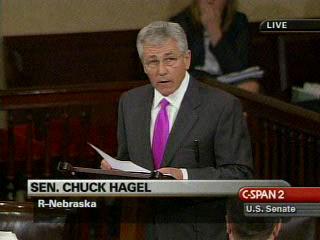
Chuck Hagel gave us another example of why he should lead our nation. He puts governing before politics. That is the hallmark of a statesman. The following were his remarks from the Senate floor during the debate on the recent Iraq resolutions.
Technorati tags: Senator Chuck Hagel, Iraq
"Congress fails in its duty when we do not probe, when we fail,we do not ask tough questions, and we fail when we do not debate the gate issues of our day.
There is no issue more important than war. The war in Iraq is the defining issue on which this Congress and the administration will be judged.You can see the video of his remarks here.
The American people want to see serious debate about serious issues from serious leaders. They deserve more than a political debate. This debate should transcend cynical attempts to turn public frustration with the war in Iraq into an electoral advantage.
It should be taken more seriously than to simply retreat into focus-group tested buzz words and phrases like “cut and run,” catchy political slogans that debase the seriousness of war.
War’s not a partisan issue, Mr. President. It should not be held hostage to political agendas. War should not be drug down into the political muck. America deserves better.
Our men and women fighting and dying deserve better."
Technorati tags: Senator Chuck Hagel, Iraq
Thursday, June 08, 2006
Video of speech
You can get the video and the full transcript of Senator Hagel's speech on foreign policy at the October 2003 conference here. Senator Hagel's strength in foreign policy, diplomacy, and the security of our nation is one of his strongest assests as a Presidential candidate.
Wednesday, June 07, 2006
"Defining a Foreign Policy for the 21st Century"
There is a good speech that Senator Hagel gave back in October 2003 that nicely articulates some of his view on the world and foreign policy. Some of the references are a bit dated, but the challenges remain the same.
The risks that the world faces today are great, but so are the opportunities. America must not fear change. America must shape change, and lead with our world partners to a higher ground of peace and prosperity. Ours is a dynamic nation. Challenge and response are sources of strength. America will be the indispensable leader during this historic period of world transition, if it is wise enough to work with and through our friends and allies that have contributed to our vital interests since World War II. The courage and sacrifices of our armed forces in removing brutal regimes in Afghanistan and Iraq are testimony to both our strength and our values. Our economy remains strong. And our message of freedom and democracy has universal appeal.Read the whole speech at Project Vote Smart.
America's strength also comes from a power that is not so easily quantified - a deep faith and spirituality that animates our nation. This orientation is absent in many countries and societies. The American character is much defined by how we believe in each other.
An American foreign policy for the 21st century will be worthy of America if it is wise enough to: accept that we enhance our standing in the world not just through our power, but through our purpose; understand that great power has its limits, and that we must share the heavy responsibilities of world leadership with our allies; appreciate that together we can shape the interconnected realities of the world into workable and positive policies that benefit all peoples; listen to our friends and understand their interests; and balance our policies and actions with both a present and future perspective.
Subscribe to:
Posts (Atom)


